Choosing the right tool to manage your data and workflows can make a huge difference in how smoothly your projects run. If you’re torn between Stackby and Airtable, you’re not alone.
Both platforms promise to simplify your work, but which one truly fits your style and needs? You’ll discover the key differences that matter, helping you pick the perfect match to boost your productivity without the headache. Ready to see how Stackby stands out? Check it out here: Stackby. Keep reading to find out which tool will transform the way you work.

Credit: www.youtube.com
Introduction To Stackby And Airtable
Managing data and workflows efficiently is vital for businesses and teams today. Stackby and Airtable offer powerful platforms that help organize, track, and automate work. Both tools blend spreadsheets with database features to improve productivity.
This section introduces these two platforms and explains why comparing them is important for workflow management.
Overview Of Stackby: Purpose And Core Functionality
Stackby is designed to simplify data management and automation without needing advanced technical skills. It combines the flexibility of spreadsheets with the power of databases.
- Build custom databases easily with drag-and-drop features.
- Automate repetitive tasks using built-in automation tools.
- Collaborate with team members in real time.
- Connect with popular apps to streamline workflows.
Stackby works well for teams that want to keep data organized and automate processes without complex coding.
Overview Of Airtable: Purpose And Core Functionality
Airtable blends the familiarity of spreadsheets with database capabilities, aiming to make data management simple and visual. It targets users who want to organize projects, track inventory, or manage content.
- Offers customizable tables with different field types.
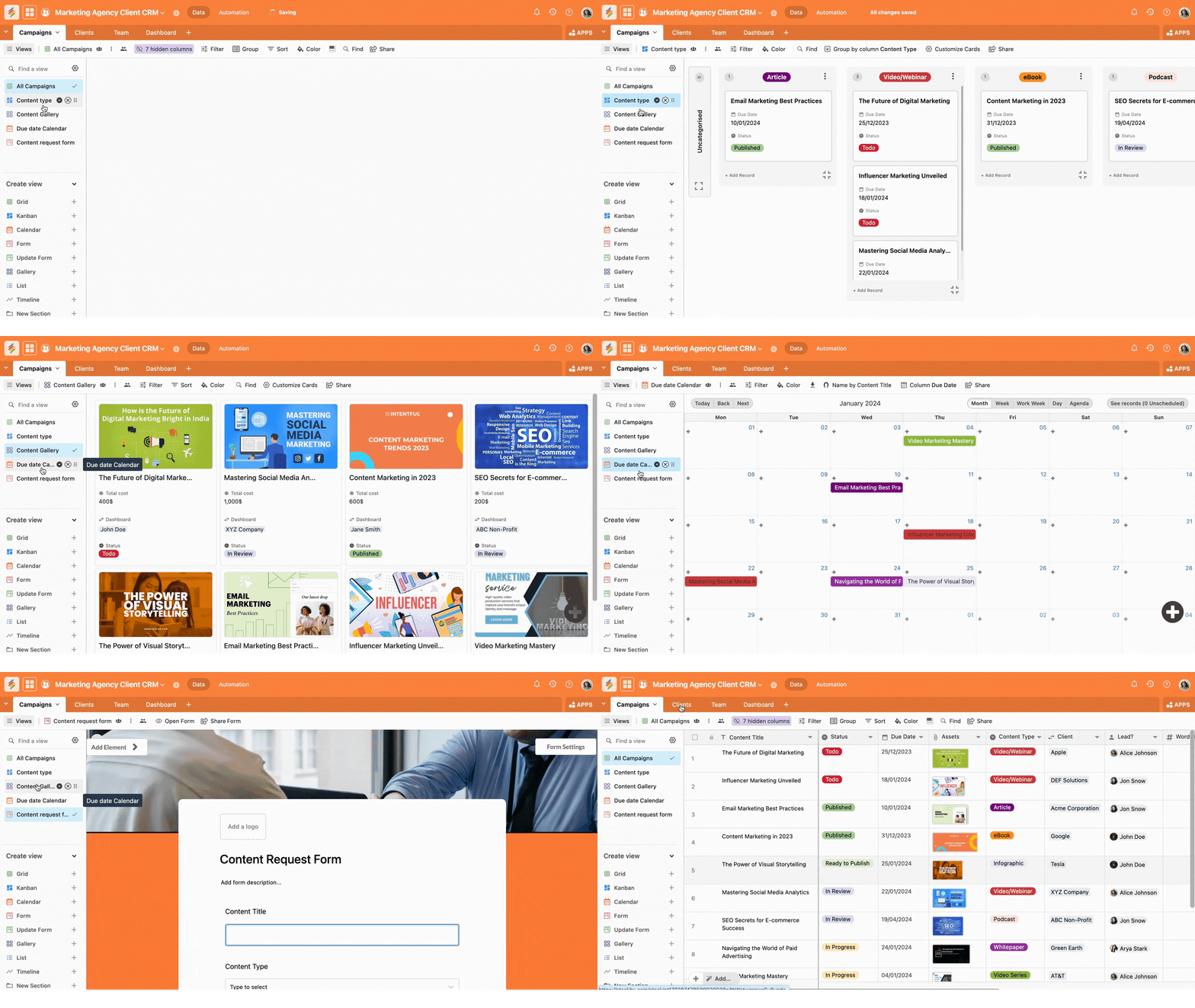
- Includes rich views like Kanban, calendar, and gallery.
- Supports integrations with many external services.
- Provides automation to reduce manual work.
Airtable appeals to teams needing a flexible and visual workspace for many types of projects.
Why Comparing Stackby And Airtable Matters For Workflow Management
Choosing the right tool affects team efficiency and data handling quality. Both Stackby and Airtable offer:
- Easy-to-use interfaces for database creation.
- Automation to save time and reduce errors.
- Collaboration features for teamwork.
Yet, their differences in customization, pricing, and integrations impact workflow management.
Understanding these differences helps teams select the best platform for their needs.
Key Features Of Stackby And Their Benefits
Stackby offers a powerful set of features that help users manage data efficiently. Its flexible design suits various tasks, from simple lists to complex databases. The platform combines the ease of spreadsheets with the power of databases. This section explores key features and how they benefit your workflow.
Customizable Columns And Data Types: Enhancing Data Flexibility
Stackby allows users to create custom columns tailored to their needs. You can choose from multiple data types, such as:
- Text
- Numbers
- Dropdowns
- Checkboxes
- Dates
- Attachments
This variety helps store different kinds of data in one place. Users can design tables that match their project requirements without extra tools.
Custom columns improve data accuracy and clarity. They reduce errors by limiting input options and provide clear data structure. This flexibility supports better decision-making and reporting.
Api Integrations And Automation: Streamlining Repetitive Tasks
Stackby connects with many apps through API integrations. These connections let data flow smoothly between tools without manual input.
Automation features help users set triggers and actions. For example, you can:
- Automatically update rows based on external data
- Send notifications when tasks change status
- Import data from web sources regularly
These automations save time and reduce human errors. They keep your data current and your team informed without extra work.
Collaboration Tools: Facilitating Team Communication And Project Tracking
Stackby supports teamwork with built-in collaboration tools. Users can share tables and assign tasks easily.
Features include:
- Real-time editing by multiple users
- Comments on rows for clear discussions
- Activity logs to track changes
- Permission settings to control access
These tools help teams stay aligned and manage projects smoothly. Everyone can see updates instantly, reducing confusion and improving productivity.
Key Features Of Airtable And Their Benefits
Airtable combines the simplicity of spreadsheets with powerful database features. It helps users organize, track, and manage data easily. The platform offers tools that suit various workflows and team sizes. Its features enhance productivity and clarity when handling complex projects.
Here are some important features of Airtable and how they benefit users.
Rich Field Types And Views: Visualizing Data In Multiple Formats
Airtable supports many field types such as:
- Text
- Attachments
- Checkboxes
- Dropdowns
- Barcode
- Ratings
- Link to another record
These fields let you store diverse data easily. Users can switch between multiple views to see data differently:
- Grid view: Classic spreadsheet style
- Kanban view: Visual task boards
- Gallery view: Image-focused cards
- Calendar view: Dates and deadlines
- Form view: Data entry forms
Visualizing data in many formats helps users understand and manage information faster.
Robust Integration Ecosystem: Connecting With Popular Apps Seamlessly
Airtable connects easily with many popular apps. It supports over 1,000 integrations through native tools and services like Zapier and Integromat. Common integrations include:
- Slack for team communication
- Google Drive for file storage
- Trello for project management
- Mailchimp for email marketing
- Salesforce for CRM
These connections allow automatic data syncing and workflow automation. It reduces manual work and errors.
Advanced Collaboration And User Permissions: Managing Teamwork Efficiently
Airtable offers strong collaboration tools to keep teams aligned. Users can:
- Comment directly on records
- Tag team members for notifications
- Share bases with different access levels
Permission levels include:
| Permission Level | Access Rights |
|---|---|
| Creator | Full control over bases and settings |
| Editor | Can add and modify records |
| Commenter | Can view and comment only |
| Read-only | Can view records without changes |
These controls help protect data and keep projects organized.
Credit: stackby.com
Pricing And Affordability Breakdown
Pricing plays a crucial role in choosing the right data management tool. Both Stackby and Airtable offer tiered plans. These plans vary in features, user limits, and cost. Understanding these differences helps find the best fit for your budget and needs.
Stackby Pricing Plans: What’s Included And Cost Efficiency
Stackby offers a simple pricing structure. It includes a free plan and three paid tiers:
| Plan | Price (per user/month) | Key Features |
|---|---|---|
| Free | $0 | Up to 2 collaborators, 1,000 rows per base, basic integrations |
| Starter | $5 | Up to 5 collaborators, 10,000 rows, API access, automations |
| Pro | $10 | Up to 15 collaborators, 50,000 rows, advanced automations, priority support |
| Enterprise | Custom Pricing | Unlimited collaborators, rows, dedicated support, custom features |
The pricing is affordable for small to medium teams. Stackby focuses on cost efficiency with automation and API features included early.
Airtable Pricing Plans: Features Vs. Price Comparison
Airtable also offers a free plan and three paid plans:
| Plan | Price (per user/month) | Key Features |
|---|---|---|
| Free | $0 | Unlimited bases, 1,200 records per base, essential integrations |
| Plus | $10 | 5,000 records per base, more storage, revision history |
| Pro | $20 | 50,000 records, advanced blocks, custom branded forms, priority support |
| Enterprise | Custom Pricing | Advanced security, unlimited records, dedicated support |
Airtable’s plans offer strong features but at a higher cost. Advanced tools appear only in pricier tiers.
Which Platform Offers Better Value For Different User Needs
Small teams or startups benefit from Stackby’s low-cost plans. It includes automations and API features early.
Users needing advanced customization may prefer Airtable. It has powerful blocks and branding but costs more.
Large organizations will find both offer enterprise solutions. Stackby’s pricing scales with usage. Airtable focuses on security and support.
- Budget-conscious users: Stackby is more affordable.
- Feature-focused users: Airtable has more advanced tools.
- Collaborative teams: Both support multiple users but differ in limits.
Choosing depends on budget size and required features. Stackby suits cost efficiency. Airtable fits feature depth.
Pros And Cons Based On Real-world Usage
Choosing between Stackby and Airtable depends on understanding their real-world strengths and limitations. Each platform offers unique features that affect daily workflow management and project execution. This section breaks down these aspects to help you decide which tool fits your needs better.
Strengths Of Stackby: Where It Excels In Workflow Management
- Customizable Tables: Stackby allows users to build databases with flexible columns and data types.
- Automation Features: Automate repetitive tasks easily without coding skills.
- Integration Options: Connect with popular apps to streamline data flow.
- User-Friendly Interface: Simple design helps non-technical users manage workflows effectively.
- Cost-Effective Plans: Affordable pricing suits small teams and startups.
These strengths make Stackby a strong choice for teams needing quick setup and automation without technical overhead.
Limitations Of Stackby: Potential Drawbacks To Consider
- Limited Advanced Features: Some complex database functions are missing.
- Smaller Template Library: Fewer ready-to-use templates compared to competitors.
- Performance with Large Data Sets: May slow down when handling very large tables.
- Mobile App Limitations: Mobile experience is less polished than desktop.
These factors may affect users with complex needs or who require extensive mobile use.
Strengths Of Airtable: Key Advantages For Smart Workflows
- Rich Template Collection: Wide variety of templates for different industries and use cases.
- Powerful Collaboration: Real-time editing and commenting improve team communication.
- Advanced Data Linking: Strong relational database capabilities enable complex project tracking.
- Robust Automation: Built-in automation for notifications, approvals, and task assignments.
- Extensive Integrations: Connects with many third-party apps for seamless workflows.
Airtable fits well for teams needing advanced project management and extensive collaboration.
Limitations Of Airtable: Challenges Users Might Face
- Higher Cost: Pricing can be expensive for larger teams or advanced features.
- Learning Curve: Some features require time to master for new users.
- Data Volume Limits: Certain plans restrict the amount of data stored.
- Complexity for Simple Tasks: Overkill for users needing basic data management.
These challenges may discourage small teams or beginners from fully adopting Airtable.
Ideal Users And Use Cases For Stackby And Airtable
Choosing the right tool depends on the specific needs of users and their projects. Stackby and Airtable both offer powerful solutions for data management and collaboration. Each platform suits different user groups and project types. Understanding their ideal users and use cases helps pick the best fit.
Best Scenarios To Use Stackby: Who Benefits Most
Stackby is perfect for users who want to build databases and automate workflows without coding skills. It suits small businesses, startups, and teams with limited technical resources.
- Data-driven teams needing an easy way to manage and update databases.
- Marketing teams tracking campaigns, leads, and content calendars.
- Project managers wanting simple automation for repetitive tasks.
- Individuals or freelancers managing personal workflows and client data.
Stackby’s intuitive interface allows quick setup of tables, formulas, and automation. Users benefit most from its blend of spreadsheet familiarity and database power.
Best Scenarios To Use Airtable: Target Users And Projects
Airtable targets a broad range of users, from small teams to large enterprises. It works well for complex projects needing rich collaboration and customization.
- Creative teams managing content production and editorial calendars.
- Product teams tracking development cycles and bug reports.
- Event planners coordinating schedules, vendors, and attendees.
- Large organizations requiring scalable workflows and extensive integrations.
Airtable’s flexible views, advanced filtering, and app marketplace make it ideal for diverse industries and project scales.
Choosing The Right Tool Based On Workflow Complexity And Team Size
| Factor | Stackby | Airtable |
|---|---|---|
| Workflow Complexity | Simple to moderate workflows with basic automation | Moderate to complex workflows with advanced customization |
| Team Size | Small to medium teams (up to 20 users) | Small teams to large enterprises (unlimited users) |
| Technical Skills Required | Minimal technical skills needed | Basic to intermediate skills to leverage full features |
| Collaboration Features | Essential collaboration tools | Advanced collaboration with comments, notifications, and integrations |
Teams with straightforward needs and smaller groups find Stackby easier and faster to implement. Larger teams or projects demanding detailed tracking and integration benefit more from Airtable’s robust features.
Conclusion: Making The Smart Workflow Choice
Choosing the right workflow tool impacts productivity and project success. Both Stackby and Airtable offer unique features to streamline work. Understanding their key differences helps pick the best fit for your needs. This section breaks down benefits, offers final advice, and shares tips for working efficiently with either platform.
Summarizing The Key Differences And Benefits
| Feature | Stackby | Airtable |
|---|---|---|
| Ease of Use | Simple drag-and-drop interface, easy for beginners | User-friendly but with a steeper learning curve |
| Automation | Built-in automation for workflows without coding | Strong automation with integrations and scripting |
| Data Management | Flexible database building with spreadsheet style | Rich relational database with extensive views |
| Pricing | Affordable plans with good features | Higher pricing but more advanced options |
| Collaboration | Real-time collaboration and easy sharing | Robust team features and user permissions |
Stackby suits users who want quick setup and easy automation. Airtable fits teams needing complex databases and integrations.
Final Recommendations For Selecting Stackby Or Airtable
- Pick Stackby if you prefer a spreadsheet-like setup with strong automations.
- Choose Airtable for advanced database needs and deep integrations.
- Consider your budget and team size before deciding.
- Test both platforms with free plans to assess fit.
- Focus on the features that match your daily tasks.
Tips For Maximizing Workflow Efficiency Regardless Of Choice
- Define clear goals for your workflow before building databases.
- Use templates to save time and maintain consistency.
- Automate repetitive tasks to reduce manual work.
- Regularly review and update your workflows for improvements.
- Train your team on essential features and best practices.
- Integrate with other tools to centralize your work.
Efficiency comes from planning, using automation, and continuous improvements.
Credit: www.youtube.com
Frequently Asked Questions
What Are The Main Differences Between Stackby And Airtable?
Stackby combines spreadsheets with databases, offering API integrations and automation. Airtable focuses on user-friendly database management with many templates and extensive third-party app support. Stackby suits automation-focused users, while Airtable appeals to teams needing flexible collaboration tools.
Which Tool Is Better For Project Management?
Airtable excels in project management due to its visual views and robust collaboration features. Stackby is good for data-heavy projects requiring automation. Choose Airtable for task tracking and teamwork; choose Stackby if you need custom API workflows.
How Do Pricing Plans Of Stackby And Airtable Compare?
Stackby offers affordable plans with generous API calls and automation limits. Airtable’s pricing is higher but includes more advanced features and integrations. Both offer free plans; select based on your feature needs and budget constraints.
Can Stackby And Airtable Integrate With Other Apps?
Yes, both support integrations. Airtable has a broader ecosystem with native apps and Zapier. Stackby also supports API and Zapier but focuses more on automation with built-in API connectors. Integration choice depends on your workflow needs.
Conclusion
Both Stackby and Airtable offer strong tools for organizing data. Stackby stands out for easy automation and simple database building. It suits users without deep tech skills well. Airtable has many templates and integrations for varied needs. Choosing depends on your workflow and team size. Want a smooth data experience with less hassle? Try Stackby and see how it fits your projects. Simple, clear, and effective.